|

More
Memoir Writing and Publishing Tips See Ina's article on tips to get started, on expert site, SelfGrowth.com
|
||
|
|||
|
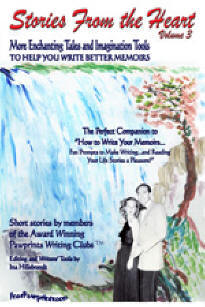
Among the tools we use to stimulate creativity and help people write stories of their own lives, are Ina's Weird Prompts™. We also use prompts (first lines and titles for stories) from the book, How to Write Your Memoirs...Fun Prompts to Make Writing...and Reading...Your Life Stories a Pleasure! and from Diving Boards. Why include offbeat prompts, that usually lead to fiction? Because they loosen us up to write more creatively, and even help to recall stories from long ago. All in all, both memoirs and fiction are better for the exercise. Writing is enriched, the writers have fun, and so do those of us who get to read the stories! What's also fun to see is how everyone's voice comes through. No two stories from the prompt below are alike. Take a look at what happens from the prompt, The first stories below are from our latest class book, Stories From The Heart, Vol. 3. And then there's a brand new tale from Harrison Stephens, inspired from the stories by our authors at our Spoken Word show, during which he graciously played, along with Ira Westley. What an up!!! Try using a prompt yourself, after reading these stories. As Harrison put it,
|
|||
|
|
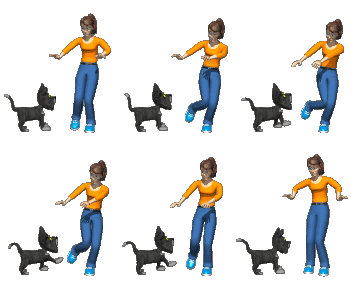
Prompt: "The moment the black cat stepped in front of me, I knew..."
Prompt and stories © 2007 Ina Hillebrandt. All rights reserved. |
||
| Short stories from the book, "Stories From The Heart, Vol. 3": | |||
 |
GOOD LOUIS/BAD LOUIS By Louis Weinstein |
||
|
The moment the black cat stepped in front of me, I knew, as the saying says, bad luck was on its way. But what was I to do about it?
I had been a good child, did what my mom told me even before she told me. Never cheated in games, either physical like hand ball or intellectual like checkers. Didn't steal a piece of candy from the corner candy store when Mr. Sharp's back was turned. Did my school work on time, ran errands for neighbors, all of these and much more as I went through my twenties to forties and now past middle age. What had I done wrong?
I happened to glance at the clock. It was time for my favorite TV program. Suddenly, breaking news came on. There was George Bush, whom I had just voted for. My answer to my forthcoming bad luck was right there on CBS.
|
|||
|
|
|
||
|
A cat lover I have never been. Since early childhood I had a longing to escape any sight of a “house cat” or a stray.
It probably began when I was three. Mr. Cat (no, it must have been Mrs. Cat, I’ll tell you why later) belonged to Mr. Cassell, our neighbor on the second floor.
The first floor was occupied by my father’s business — haberdashery, wigs and toupees, curly false hair pieces. Our apartment was on the third floor. So Kitty Cat, on the second floor, was always underfoot.
One day, I can’t tell why, I developed an aversion to her and I can’t even remember her name. But she was there and loved by everyone, except Sophie. Why? Was I jealous? Being an only child, did I crave all the attention? Could well be.
Anyhow, be that as it may, one day there was a lot of commotion, and instead of one cat, there was a litter! Oh, my! Now to find homes for three or four kittens, which Mrs. Cassell did in no time.
So Mother Kitty Kat was an accepted member of the family and we all lived happily ever after.
Except Sophie. |
|||
|
|
BLACK CAT By Kay Roberts |
||
|
The moment the black cat stepped in front of me, I knew I was in the right place. Of course I took the precaution of turning around three times and spitting. As everyone knows that is the only way to keep the jinx from affecting you.
I’m not superstitious, but I will not take unnecessary chances. What if there was something to these things? There must be a reason they have been around for so long. I always toss spilled salt over my left shoulder. Avoid walking under ladders. Try not to step in cracks even if my mother is gone, and can’t sustain an injury from my doing so.
I count my sneezes so I can know what they portend. Everyone knows I’m a sensible person and don’t believe in silly things but still here I was on my way to the wishing well to ask for a change of luck. |
|||
|
NOT EXACTLY WISTERIA LANE
|
|
||
|
The moment the black cat stepped in front of me, I knew that the witch was on her way. She always followed six seconds after the cat. The cat, whose name was Oz, would look back and there would be our Village Witch.
We were very fortunate. Not every village had a witch and not every witch had a cat. One witch in a village far away had a dog named Toto.
We would all gather round and wait for Wisteria the Witch as she would grant favors if she was in the mood. She was particularly fond of handsome young men, and sometimes bestowed small favors on them if they kissed her hand and told her how beautiful she was.
Now, lying came easily to the men of this village, so Wisteria would grant a lot of favors, especially to her favorites. Favors for the favorites.
Then as she left the black cat would look back and wink, because he would never tell Wisteria that she was the ugliest witch of all.
NEWS! Laurel,
and other folks now in our class who will be appearing for the first
time in Book 4, are featured in a commercial jingle contest for Oreo
cookies. You can see them on the Oreo site.
https://www.nabiscoworld.com/oreo/jingle/default.aspx.
Click on the spelling bee commercial shot in LA. And you can put in a
vote for them -- they'll win a trip to New York, have a lot more fun,
and they really did a swell job! You'll be taken to a sign-up screen to
establish an account that allows you to vote, and from then on you can
vote every day until September 4, by using just your user
name and password. |
|||
|
|
|
||
|
The moment the black cat stepped in front of me I knew. I was not superstitious, but my mother sure was. To her, all cats were an abomination. My mother had even less tolerance for dogs. Absolutely no dogs were allowed for pets. However, she did tolerate, up to a point, one large gray and white tom cat that we had as young children. Though the cat was never allowed in the house, winter or summer, practically every day after milking the cow I would pour some of the warm milk in a dish for him. Stray cats were another matter to us kids. They suffered a terrible fate in our hands. They were caught and a string of tin cans tied to their tails. In wild horror they ran away and were never seen again. In my adult life I have never been a cat lover, but I have tolerated strays. I don’t catch and tie tin cans on their tails anymore, but I don’t bother to feed them either, except unintentionally when I throw food scraps on the compost pile.
|
|||
|
The story below is from our talented guitarist friend, Harrison Stephens, whose work is not in the book, but who, to our delight, said he was "stimulated to write this little story" from the black cat of "Ina's Weird Prompts" after generously donating his services and time to play in our most recent show ...We're awfully glad he felt so inclined, on both counts... |
|||
|
|
|
||
|
The moment the black cat stepped in front of me I knew him. I can’t say that we were friends, but we’d met. Identification was easy. He’d stand out in a police lineup of black cats. He had a torn ear and an unnatural kink in his tail, emblems, I suppose, of old battles won or lost. I’d seen him in my back yard from time to time. Maybe he’d once caught a mouse or a bird there and was prowling for more.
He was feral as a coyote and had the wary ways of all such animals. If I’d call “Kitty, kitty,” he’d stop at a safe distance and stare at me with his big yellow eyes. They seemed particularly bright and baleful against his ebony face, and he watched me with what I fancied to be a combination of apprehension and contempt. Sometimes he’d sit down insolently and tidy up some spot on his glossy black fur, emphasizing the contempt, I thought. But if I made a move toward him he was gone. One day I looked out the kitchen window, saw him and, in a mischievous moment, crumbled some raw hamburger onto a saucer. I put it on the porch step and sat down in the swing to test his courage. He crept toward the feast a few steps at a time, watching me intently. Finally he arrived at the dish. Scarcely taking those yellow eyes away from my face, he gobbled all the meat, backed away as if waiting for some sort of trap to spring and skittered out of the yard as though he’d stolen something. I didn’t see him again for a week or so.Now here he was in front of me, much closer than usual, and he had troubles. Only one yellow eye glowed in his face. The other was half closed. I sat down in the porch swing again to see what would happen. The cat suddenly bounded up on the porch and then onto the swing next to me, and I could diagnose the eye problem. It was a barley bristle—one of those pesky, one-way darts that catch in your socks when you cut across a weedy lot. In some way the bristle had gotten under the cat’s eyelid, pierced the lid and worked half its length through it, providing a constant brush against his eyeball. It must have been maddening. I went in the house for tweezers and fingernail scissors. The cat hadn’t moved when I came out; I’d rather thought he wouldn’t. I put him on my lap, receiving no objection, grasped the bristle top with the tweezers, snipped off the lower prickles and gently pulled what was left on through. Still on my lap, the cat licked a paw, swiped it over the just-freed eye and blinked a couple of times to be sure he had two functioning orbs. Then he jumped off my lap and left the yard, but this time he didn’t skitter. He walked out majestically with that crooked tail high in the air. I
haven’t seen him again yet, but perhaps now I can consider that he and I
are friends after all. Or maybe he perceives the episode as conning the
enemy into doing his bidding. He is, after all, a cat. |
|||
|
A bit about Harrison... Harrison graduated as a journalism
major from Stanford University, and worked for several publications,
with time off the U.S. Navy in WWII. Later, he had his own weekly for
three years, then spent twenty years in various newsroom tasks at the
daily Pomona Progress-Bulletin, the last as news editor. He spent his
twilight career years working as director of information at the
Claremont Colleges. Since retirement, Harrison’s written (on
consignment) four non-fiction books, numerous articles, and in his
“doddering years” writes columns for the Balboa Yacht Club and Stanford
magazines, and plays gigs with a small jazz combo. He lives with wife
Doris in Claremont, CA. The couple has two sons, two daughters, ten
grandchildren, and, at last count, fourteen great-grandchildren. |
|||
| Prompts and stories © 2007 by the authors and Ina Hillebrandt. All rights reserved. Page updated March 2015. | |||
|
Prompts and stories © 2007 by the authors and Ina Hillebrandt. All rights reserved. |
|||