|
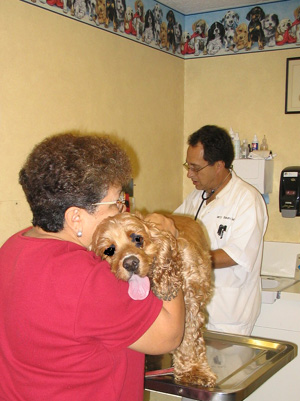
Dr. Baum treats cocker Porky
for owner, Aida
Venegas
Back
pain is a common affliction in both dogs and cats. In some
instances the discomfort is caused by something as simple as a
strained muscle, often the result of vigorous jumping and twisting.
However, in other cases the pain may be associated with permanent
injuries which can cause repeated bouts of discomfort. The key to
understanding back problems lies in the knowledge of how discs
function.
The
bones of the spinal column (vertebrae) are separated from each other
by pad-like structures called discs. These pads resemble vitamin e
capsules; they have a tough elastic exterior that surrounds a soft,
fluid center. The spinal cord runs just over the disc in a bony
tunnel through the vertebrae. When something happens to weaken the
elastic exterior of the disc, the shape becomes altered and a bulge
occurs, much like the bubble you would see in an inner tube of a
tire. When the bulge pushes upward and into the bony tunnel
containing the spinal cord, an increase in pressure occurs and the
actual spinal cord starts getting squeezed; hence the term, pinched
nerve. In more severe conditions, the bubble can actually rupture
and release the fluid contents of the disc directly into the
tunnel. Not only does this disc material take up space in the
tunnel, but it also causes a severe inflammation, which further
squeezes the spinal cord. The severity of symptoms is related to
the degree of spinal cord compression. Mild bulging of the disc
produces pain but as the pressure in the tunnel increases numbness
and weakness become apparent and in the most extreme cases, total
paralysis can ensue.
A
less severe problem known as spondylitis can also affect the back.
Also known as spinal arthritis, this condition occurs when there is
a lack of stability between adjacent vertebrae, and the body
produces extra bone in an attempt to unite the unstable bones.
Typically, symptoms of stiffness and difficulty getting up occur
with this condition.
In
order to diagnose the problem, x-rays of the spinal column need to
be taken. Very often a sedative will need to be given prior to the
films to insure adequate muscle relaxation, which will allow an
accurate evaluation of the disc spaces. In some cases, a myelogram
(an x-ray combined with an injection of dye around the spinal cord)
will need to be done to pinpoint the exact location of a problem
prior to surgery.
Treatment regimens can vary for the above conditions, varying from
mild analgesic medication such as buffered aspirin to
anti-inflammatory drugs such as Prednisone. In severe cases,
surgery may be the only solution. Consult with your local
veterinarian for the advice that will benefit your pet.
Next
week: Dr. Baum, what should I do with two cats who are, shall
we say, of the same sexual persuasion, but who suddenly are having
their way with each other?
|